BOND
0-2 Minutes: Bond with the baby. Do not cut the cord for one full minute. The extended bonding time is only interrupted for the one minute it takes to deliver the placenta in squatting.

Evaluate your risk of intervention and protocol violation in 3 clicks.
1. Is this your first vaginal birth after a previous Cesarean (VBAC)?
Hospitals define 'Safety' as losing 1,000mL of blood. We define it as losing 0.
In 2017, the ACOG officially redefined PPH, from the previous definition of 500 cc or more to blood loss of 1,000 mL or more [1]. Instead of fixing the problem of excess blood loss, they changed the definition.
Current protocols are not optimizing maternal outcomes. They even occasionally cause preventable maternal death. Pitocin can cause extreme postpartum pain, making it impossible to bond or nurse. Hemorrhage causes 1% of women to lose so much blood they require a blood transfusion, which exposes them to toxic dangers. Controlled Cord Traction (pulling) carries a risk of the cord snapping—causing the newborn to lose blood—as well as Uterine Inversion, a life-threatening emergency [1].
If the Gravity Protocol became the global standard of care, the projected hemorrhage rate drops to 0%. We are not just trying to change hospital policy. We are trying to save 70,000 mothers a year.
Mammals never give birth to the placenta lying on their backs.
Chimpanzees share 99% of our DNA and have the identical placental attachment as humans. Yet, they do not suffer from Postpartum Hemorrhage.
The Difference?
Every mammal except humans gives birth to the placenta in squatting. Gravity helps them.
Only humans are forced to lie flat on their backs.
Hemorrhage is not a biological flaw. It is a gravity error.
"Nature follows fundamental laws of physics."
Judy Slome Cohain is a field researcher & Midwife with over 43 years of clinical experience. While modern hospitals rely on pharmaceutical interventions, Judy focused on the physics of the human body.
First discovered in 2005 and published in 2010, the protocol is based on hard data. She documented 2,149 consecutive vaginal births using the Gravity Protocol. Her findings challenged the global medical establishment by proving that hemorrhage is not "inevitable"—it is often caused by the very interventions meant to prevent it [2].
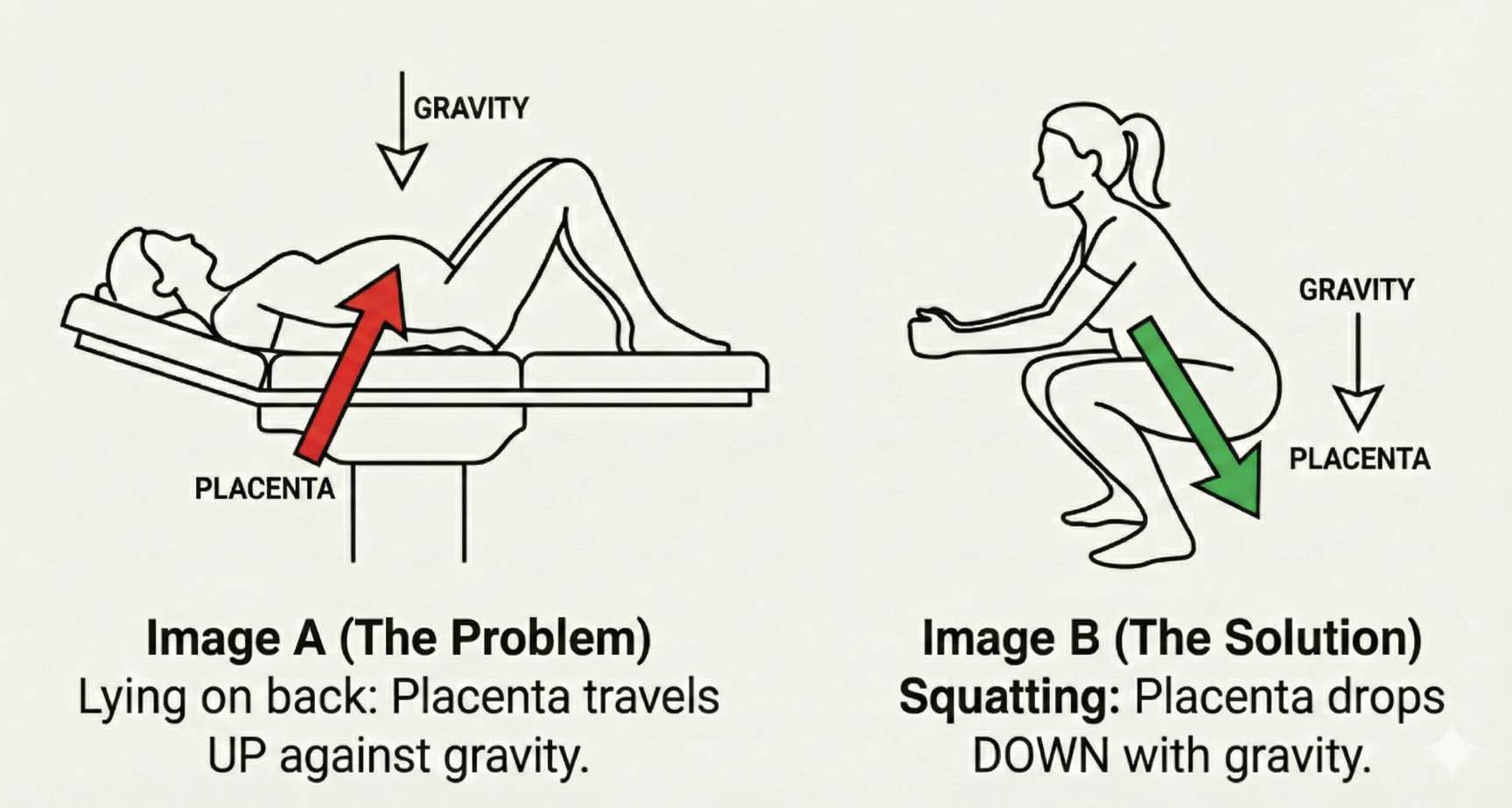
Tap to switch views. Left: Fighting Gravity. Right: Using Gravity.
Currently, the loss of 1,000 cc or less is considered normal by the establishment. The JSC Protocol results in a 100 cc average blood loss (including the birth and the first 2 hours after birth). The JSC protocol guarantees less than 500 cc blood loss by using simple physics—alignment, expedience, and gravity.
0-2 Minutes: Bond with the baby. Do not cut the cord for one full minute. The extended bonding time is only interrupted for the one minute it takes to deliver the placenta in squatting.
Minute 2: Get into a squatting position. This aligns the birth canal vertically. Push without waiting for a contraction. Gravity now assists the separated placenta downward.
Minute 3: The mother pushes the placenta out using her own muscles with the assistance of gravity. If the placenta does not deliver by 3 minutes postpartum, gentle traction may be used while remaining in the squatting position.
In the delivery room, a verbal "No" is often ignored. Doctors are trained to follow hospital protocols, even if those protocols are outdated.
Hospitals run on liability and fear of lawsuits. This letter CLEARLY PLACES the liability ON them. If they violate your written directive, they are legally exposed.
When a doctor READS a signed, formal refusal "TO DELIVER THE PLACENTA LAYING DOWN," they stop treating you like a passive patient and will be forced to realize how logical your request is.
By placing this in your file, you create a permanent record. If they prevent you from squatting at 2 minutes and you bleed, the 'Refusal' button on the digital form proves they acted against your will.
Yes. The baby has continuous bonding with the mother from 0-2 minutes and from 3 minutes on. The mother finishes the placental delivery expediently, giving her more time to focus on the baby. Because the mother has less bleeding, she feels significantly better for the next 6 months [2].
Squatting recruits the abdominal muscles and diaphragm more effectively than lying down. It takes less effort to work with gravity than against it [2].
The placenta separates within 1 minute except in the case that the placenta has abnormally grown INTO the uterine wall, which among women who have not had a cesarean in the past happens at 1 in 2,000 births. Waiting too long allows the cervix to close, trapping the placenta inside. If more than 5 minutes pass before the placenta delivers, 5% to 10% of women will hemorrhage over one liter or over one third of their blood volume. Speed is safety.
"I don't want a shot of anything to contract my uterus, such as Pitocin."
"I refuse routine cord traction in the supine position. I will hold my baby for 2 minutes."
"I want you to tell me when exactly 2 minutes have passed and remind me to get into squatting. I will push my placenta out by 3 minutes in squatting."
"If it has not delivered by 3 minutes, you can pull very gently on the placenta to help bring it down."
Join the global network of mothers and providers. Get updates on the protocol.
Live, undeniable proof. Drop a pin if you used the Gravity Protocol to achieve optimal blood loss.